Agentic AI Investment in 2026: The Complete Guide to AI Autonomous Investing
May 14, 2026 • 25 min read
Updated: May 2026 | Reading time: ~14 minutes | Author: sandx.ai Research Team
What is agentic AI Investment (Trading) ? The short answer: Agentic AI investment uses autonomous, goal-directed AI systems — not just algorithms — to analyze markets, form strategies, manage risk, and execute trades with minimal human intervention. Unlike traditional algo trading, these systems reason, adapt, and coordinate the way a professional trading desk does.
If you've been watching the rise of AI in finance and wondering whether it's hype or a genuine structural shift in how retail investors compete — this guide gives you the data, the mechanics, and the tools to decide for yourself.
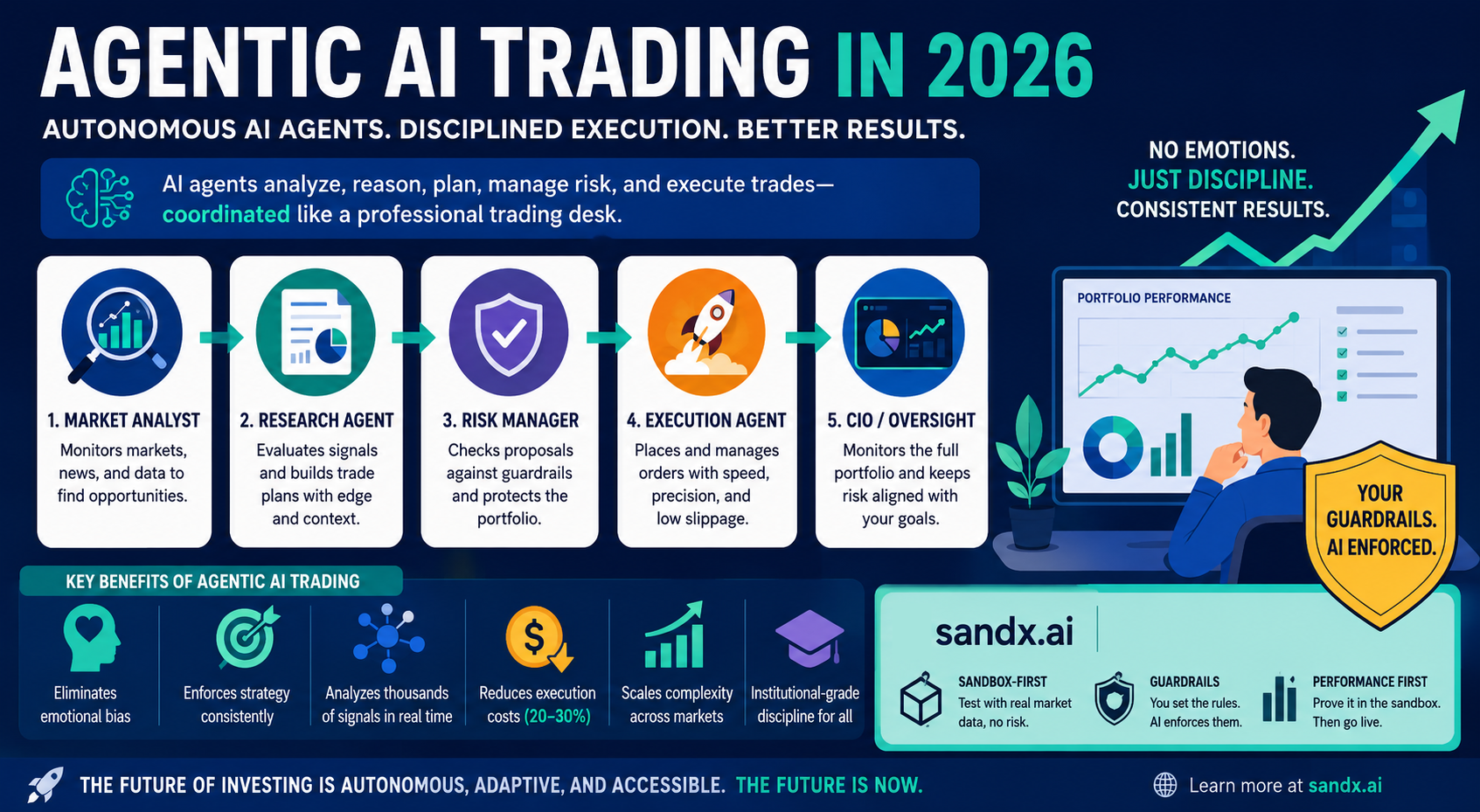
Table of Contents
-
How Is Agentic AI Trading Different from Algorithmic Trading?
-
Why Emotional Trading Is Costing Retail Investors More Than They Realize
-
What Is sandx.ai? Introducing the Agentic Trading Platform for Retail Investors
What Is Agentic AI Investment?
Agentic AI Investment (trading) refers to the use of autonomous AI agents — systems that perceive data, reason, plan, and act — to manage investment decisions across multi-step, real-world trading workflows.
The word agentic is key. Traditional algorithmic trading follows fixed rules: "if price crosses this moving average, buy." Agentic AI operates differently. It sets goals, gathers context from multiple data sources, makes decisions under uncertainty, adapts when circumstances change, and can even coordinate with other AI agents to perform complex, interconnected tasks.
Think of it this way: a trading algorithm is a vending machine — it executes what you program. An agentic AI trading system is closer to a junior portfolio manager — one that never sleeps, never panics, and doesn't act on a hot tip from a group chat.
The Core Components of an Agentic AI Trading System
A properly architected agentic trading system typically includes:
-
Perception layer — ingests real-time market data, news feeds, earnings reports, macroeconomic indicators, and alternative data
-
Reasoning engine — uses large language models (LLMs) or specialized financial models to interpret signals and build hypotheses
-
Planning module — translates hypotheses into actionable trade plans with defined entry/exit logic and position sizing
-
Execution agent — interfaces with brokerage APIs to place, modify, and close positions with speed and precision
-
Risk management agent — monitors portfolio exposure, enforces guardrails, and escalates to human oversight when uncertainty crosses thresholds
-
Memory / learning layer — retains context from prior sessions, logs outcomes, and improves decision-making over time
When these components work in concert, you get something that looks less like a bot and more like a coordinated trading desk — automated, scalable, and operating within rules you define.
How Is Agentic AI Trading Different from Algorithmic Trading?
The fundamental difference: algorithmic trading executes predetermined rules; agentic AI trading reasons, adapts, and coordinates to achieve goals.
| Feature | Algorithmic Trading | Agentic AI Trading |
|---|---|---|
| Decision logic | Fixed, rule-based | Goal-directed, adaptive |
| Response to new data | Executes pre-set conditions | Reasons and updates strategy dynamically |
| Multi-step planning | Limited | Core capability |
| Agent coordination | Single bot | Multi-agent collaboration |
| Context window | None | Persistent memory across sessions |
| Complexity of tasks | Single-function | Up to 12× more complex than LLMs alone |
| Strategy adaptation | Requires manual reprogramming | Autonomous re-evaluation |
| Human oversight model | Monitor rules | Define goals + guardrails |
Traditional algorithmic trading relies on a developer explicitly encoding every decision branch. Agentic AI systems, by contrast, can handle ambiguity — they observe context, reason about it, and select from multiple possible actions.
According to market research, agentic systems complete up to 12 times more complex tasks than traditional large language models due to their dynamic feedback loops and multi-step planning capabilities. That's not an incremental improvement — it's a different category of capability.
Why Emotional Trading Is Costing Retail Investors More Than They Realize
The biggest enemy of the retail investor isn't the market — it's their own psychology. And the data is unambiguous.
Between 70% and 95% of retail traders lose money, depending on the market and timeframe studied (FINRA, SEC). The primary culprits are not poor strategy selection or bad market timing — they are behavioral: FOMO, panic selling, anchoring bias, overconfidence, and loss aversion.
Consider what this looks like in practice:
-
An investor holds a losing position for too long because selling "feels like" accepting failure
-
A winning position gets closed too early because the profit feels good right now
-
A volatile day triggers a panic sell at the bottom, minutes before the recovery
-
A hot sector drives overallocation — five times the intended position size — because the narrative feels bulletproof
These are not edge cases. The Dalbar Quantitative Analysis of Investor Behavior consistently shows that the average retail investor significantly underperforms the market indices they're invested in — not because the market is rigged, but because human psychology is poorly suited for short-term decision-making under uncertainty.
Agentic AI systems don't have these cognitive biases. They don't feel euphoric after a win. They don't hesitate at a defined stop-loss. They don't add to a losing position because they're "sure it'll bounce back." They enforce the rules the investor sets — even when the investor's gut says otherwise.
This consistency is arguably the single most undervalued benefit of AI-driven trading for retail participants.
The Market Data: How Fast Is Agentic AI Growing?
Agentic AI is the fastest-growing segment of enterprise technology in 2026. The financial services sector is one of its most active deployment zones.
Here are the numbers that matter:
Agentic AI Market Size
-
The global agentic AI market was valued at 9–10.8 billion in 2026, depending on the research source
-
The long-range forecast: $139–196 billion by 2034, implying a compound annual growth rate of 40–44%
-
For context, no enterprise technology sector has grown this fast since the early cloud migration wave — and unlike cloud, agentic AI affects every business function simultaneously
AI in Financial Trading
-
The **AI in trading market hit 45.74 billion by 2030 (13.2% CAGR)
-
AI now powers an estimated 89% of global trading volume through advanced algorithms and autonomous systems
-
The **algorithmic trading market reached 29.54 billion by 2031
-
The retail investors segment is the fastest-growing sub-category of algo trading, expanding at an 8.32% CAGR through 2031 — driven by fintech democratization
Adoption Reality Check
-
79% of organizations report some level of agentic AI adoption — but only 11% run AI agents in full production
-
43% of enterprises are actively considering agentic AI adoption in 2026
-
40% of enterprise applications are expected to embed task-specific AI agents by end-2026 (Gartner)
-
93% of business leaders believe organizations that scale AI agents in the next 12 months will gain a decisive competitive advantage
The gap between the 79% experimenting and the 11% shipping in production represents the largest deployment backlog in enterprise technology history. The organizations — and individual investors — who close that gap first will capture disproportionate advantage.
How Agentic AI Trading Systems Actually Work
A well-designed agentic trading system functions like a multi-person trading desk, with specialized agents handling distinct roles in a coordinated workflow.
Here's a concrete walkthrough of how a multi-agent trading system operates during a single market session:
Step 1: Market Analysis
The process begins by delegating initial market analysis to the Market Analyst agent. This agent provides a broad market overview, identifies key trends, and establishes the macro context that every subsequent decision will depend on. No ticker analysis happens until this step is complete.
Step 2: Equities (Tickers) Selection
If the user does not specify which stocks to evaluate or trade, the system delegates ticker selection to the Equity Selection Analyst to select the equities to review based on the market analysis provided in Step 1. This ensures that every ticker under consideration is evaluated within the correct market context and aligned with the current opportunity environment.
Step 3: Deep Dive Analysis (Per Stock)
For each selected ticker, the system executes four parallel delegations, each handled by a specialized agent:
-
3.1 Equity Research Analyst: Requests current news and narrative analysis
-
3.2 Fundamental Analyst: Requests valuation and financial health analysis
-
3.3 Technical Analyst: Requests technical analysis of price patterns and indicators
-
3.4 Risk Analyst: Requests risk analysis, including downside scenarios and correlation metrics
These four analyses run simultaneously for each ticker, not sequentially. The
system doesn't wait for one to finish before starting the next.
Step 4: Reasoning & Decision Making
This is where the system's cognitive work happens, and it proceeds in four distinct phases:
-
Reflection: The system reviews historical trades using past outcomes to improve future decision-making and maximize returns.
-
Synthesis: Acting with full autonomy, the system compiles all findings: the market analysis, deep dive results across every ticker, current portfolio performance, trading history, the user's stated investment strategy, and accumulated learning notes. Nothing is left out.
-
Critical Thinking (Extremely Important Step): Before any recommendation is made, the system engages in deep, independent reasoning. This is not a mechanical aggregation of scores. It is a considered judgment that weighs conflicting signals, questions assumptions, and stress-tests its own conclusions.
-
Recommendation: The system formulates a final BUY/SELL/HOLD recommendation for each relevant ticker, complete with a detailed rationale and a precise confidence score.
Step 5: Trade Execution
If the market is open and the system has generated high-confidence recommendations (BUY or SELL), it delegates execution to the Trading Executor. The instructions provided are clear and detailed, including every ticker recommended, the action to take, quantity or allocation, confidence score, and the full rationale supporting each trade.
Step 6: Reporting
After analysis and execution are complete, the system compiles all findings, rationales, and execution results into a cohesive summary. It then sends an investment recommendation summary email to the user, so there's a clear audit trail of what was recommended, why, and what happened.
Step 7: Post-Processing
The final step is where the system improves over time. It reviews what worked versus what failed across several dimensions: thesis accuracy, timing, position sizing, risk control effectiveness, and confidence calibration. It extracts specific learnings from realized and unrealized P&L, including loss drivers, missed upside opportunities, premature exits, and overtrading. It notes any market regime changes that impacted the thesis, such as macro shifts, volatility spikes, sector rotation, or unexpected catalysts. Finally, it re-evaluates the user's investment style fit, considering risk tolerance, time horizon, concentration limits, and drawdown constraints, then adjusts its internal rules accordingly.
What Is sandx.ai? Introducing the Agentic Trading Platform for Retail Investors
sandx.ai**** is an agentic AI trading platform that gives retail investors access to a fully coordinated, multi-agent trading team, without needing a hedge fund budget or a computer science degree.
Until recently, this kind of systematic, team-based approach to investing was the exclusive domain of quantitative hedge funds. sandx.ai is changing that by building infrastructure for autonomous AI trading teams that anyone can configure, deploy, and monitor.
The Core Idea: A Trading Desk, Not a Bot
Most "AI trading" products give you a bot that follows a single rule. sandx.ai gives you a team. Users build and deploy multiple specialized AI agents, each playing a defined role and communicating with the others, to create a coordinated trading operation.
Think of it as composing your own professional trading desk:
-
Market Analyst: Deep research agent to analyzes macroeconomic trends, sector rotation, and global events to provide market context.
-
Equity Selection Analyst: Reviews market research to select high-potential tickers for deep analysis, balancing current holdings with new opportunities.
-
Equity Research Analyst: Deep research agent to analyzes company fundamentals, earnings reports, and news to find high-potential stocks.
-
Fundamental Analyst: Evaluates financial statements, management quality, and competitive advantages to assess long-term value.
-
Technical Analyst: Advanced Python Coding agent to analyzes price patterns, calculating advanced technical indicators, and action to identify optimal entry and exit points.
-
Risk Analyst: enforces your defined limits with zero emotional override
-
Chief Investment Officer: Lead and orchestrate the investment team to allocate tasks and make final decisions based on the your personalized investment strategy
-
Execution Agent: Executes orders with real-time market data and execution. Record transaction history.
Sandbox-First: Test Without Risking Capital
sandx.ai operates as a sandbox environment, a simulated trading platform powered by real market data. Users can build, test, and refine their agentic trading teams without risking real capital. When a strategy performs to their satisfaction, they can proceed to live deployment with clear performance benchmarks already established.
This matters a great deal. Most retail investors who lose money do so in the first 90 days, before they understand what their strategy actually does under different market conditions. sandx.ai's sandbox removes that risk entirely.
Guardrails Are the Product
The risk management architecture at sandx.ai isn't a feature. It's the core philosophy. Users define:
-
Maximum drawdown limits per session, per week, per month
-
Position size caps so no single position exceeds a defined percentage of the portfolio
-
Sector concentration limits to prevent overexposure to correlated assets
-
Trade frequency rules to prevent overtrading in volatile conditions
Once set, these guardrails are enforced by the AI agents automatically, even when market conditions create the temptation to override them. This is the discipline that separates systematic traders from emotional ones, and sandx.ai builds it directly into the platform architecture.
Benchmark Tracking Built In
sandx.ai tracks agent team performance against real-market benchmarks including the S&P 500 and QQQ. The goal is not just to help users avoid losses, but to give them a transparent view of whether their agentic strategy is generating genuine alpha over time. If your agents are underperforming a passive index ETF after fees, you'll see it clearly and can adjust.
Who Is sandx.ai For?
sandx.ai serves a specific kind of investor, one who:
-
Understands that their worst trading decisions happen under emotional pressure
-
Is curious about AI-driven investing but doesn't want to build their own quant system from scratch
-
Wants to test strategies rigorously before deploying real capital
-
Values consistency over excitement, because disciplined execution compounds
The platform is not for: get-rich-quick speculation, leveraged gambling, or anyone looking for guaranteed returns. sandx.ai is a tool and a platform. Results depend entirely on the user's strategy configuration and market conditions.
Key Benefits of Agentic AI in Trading
The case for agentic AI in trading rests on six well-documented advantages:
1. Elimination of emotional decision-making
Algorithmic traders experience 40% less emotional decision-making than discretionary traders (Behavioral Finance Research, 2024). Agentic AI takes this further — the system doesn't just execute faster than a human, it never feels the pressure to deviate.
2. Consistent strategy enforcement
The biggest gap between a trader's stated strategy and their actual behavior is consistency. Agentic AI closes that gap. The rules you set on a calm Sunday are the rules enforced on a volatile Wednesday.
3. Real-time multi-source analysis
Human traders can monitor a handful of signals at once. Agentic systems process thousands simultaneously — price feeds, news sentiment, options flow, macro data, earnings transcripts — and synthesize them into actionable intelligence in real time.
4. Reduced execution costs
Algorithmic trading reduces execution costs by 20–30% compared to manual execution (Trading Cost Analysis, 2023). Agentic AI further optimizes by dynamically selecting order types and routing strategies based on current liquidity conditions.
5. Scalable strategy complexity
A single human trader is limited by their cognitive bandwidth. An agentic system can run multiple strategies across multiple asset classes simultaneously — with each sub-system operating within the same overall risk framework.
6. Accessible institutional-grade discipline
Professional risk management — the kind that governs systematic hedge funds — is now configurable by individual retail investors, without writing a single line of code.
Risks, Limitations, and What to Watch Out For
Agentic AI trading is powerful. It is not infallible. Responsible adoption requires understanding where these systems fail.
Infrastructure Failure Risk
A 2025 analysis in the Journal of Trading found that approximately 22% of live algo trading losses among retail participants were attributed to infrastructure failures — connectivity outages, stale data feeds, or broken API connections — rather than bad strategy design. The execution layer matters as much as the strategy layer.
Model Bias from Poor Data
An agent is only as good as the data it ingests. Biased or incomplete datasets can create systematic errors that compound over time. Diversity of data sources and regular model evaluation are non-negotiable.
Governance and Oversight
Gartner warns that over 40% of agentic AI projects risk cancellation by 2027 due to escalating costs, unclear business value, and inadequate governance. For trading specifically, the implication is clear: AI agents need human oversight structures, audit trails, and defined escalation paths — not blind autonomy.
Regulatory Environment
The regulatory landscape for AI-assisted retail trading is evolving rapidly. India's NSE implemented a comprehensive algorithmic trading framework effective August 2025. The EU AI Act is pushing toward explainability requirements for automated financial systems. Staying current on applicable regulations in your jurisdiction is essential.
The bottom line: Agentic AI is a force multiplier for disciplined investors with a sound strategy. It is not a replacement for strategy — and it is not a substitute for understanding what your agents are doing and why.
The Future of Agentic AI in Financial Markets
The trajectory is clear: agentic AI will become the default infrastructure for systematic investing, just as electronic trading became the default for execution.
Several structural shifts are already underway:
Multi-agent coordination is becoming standard. The 2026 shift is toward multi-agent systems where specialized agents coordinate with each other — a pattern that mirrors how professional trading desks already operate.
Retail democratization is accelerating. Platforms like sandx.ai are compressing the capability gap between institutional and retail investors. The tools that required a team of quant researchers two years ago are now configurable by a motivated individual investor.
Governance infrastructure is maturing. The early years of agentic AI in finance were marked by governance gaps. 2026 and beyond will see the emergence of accountability structures, audit trail standards, and regulatory frameworks that make production deployment more reliable and legally defensible.
The talent and knowledge gap is the new moat. With 91% of business leaders saying AI agent skills will be critical for competitive advantage within three years, the investors and advisors who understand how to configure, evaluate, and improve agentic systems will have a durable edge over those who don't.
The question is no longer whether agentic AI will transform investing. The question is how quickly you get familiar with it — before your competitors do.
Frequently Asked Questions
What is agentic AI trading in simple terms?
Agentic AI trading uses AI systems that can autonomously set goals, gather information, make decisions, and execute trades — without needing a human to supervise every step. Unlike simple bots that follow fixed rules, agentic systems reason and adapt.
How is agentic AI trading different from a trading bot?
A trading bot executes a pre-programmed rule (e.g., "buy when RSI drops below 30"). An agentic AI trading system reasons about market conditions, evaluates multiple strategies, coordinates across multiple sub-agents (analyst, risk manager, executor), and adapts its behavior based on changing context.
Is agentic AI trading only for institutions?
No, that's exactly what's changing in 2026. Platforms like sandx.ai are specifically built to give retail investors access to multi-agent trading architectures that were previously available only to quantitative hedge funds.
What does a "sandbox" trading environment mean?
A sandbox environment uses real market data but simulated capital — meaning you can test your agentic trading team's performance under live market conditions without risking actual money. sandx.ai's sandbox is designed to establish real performance benchmarks before any live capital is deployed.
Can agentic AI guarantee trading profits?
No. Agentic AI is a tool that enforces discipline and processes information at a scale humans cannot match. It does not guarantee profits, eliminate market risk, or replace the need for a sound underlying strategy. Any platform that claims guaranteed returns should be avoided.
What markets can agentic AI trading systems operate in?
Current agentic trading systems can operate across US equities, ETFs, options, forex, and digital assets — depending on the platform's brokerage integrations. sandx.ai focuses on the US stock market.
How do I start with agentic AI trading on sandx.ai?
sandx.ai's sandbox environment is designed for new users to start safely — without requiring coding skills or quant backgrounds. Users configure their agent team (analyst, risk manager, execution agent, CIO), define guardrails, connect real-time data feeds, and run simulations against live market conditions before any real capital is involved.
Author Note
This post was written by the sandx.ai research team with the goal of providing factual, educational context on agentic AI trading. Nothing in this article constitutes financial advice. sandx.ai is a platform and tool — results depend on user-configured strategies and market conditions. All statistics are sourced from publicly available market research published between 2024 and 2026.
For the latest on sandx.ai's platform capabilities, performance benchmarks, and sandbox environment, visit sandx.ai.
Updated: May 2026 | Sources: Mordor Intelligence, Fortune Business Insights, Grand View Research, Gartner, FINRA, Dalbar, BarclayHedge, Journal of Trading, Behavioral Finance Research 2024, CFA Institute, QuantConnect, Technavio